
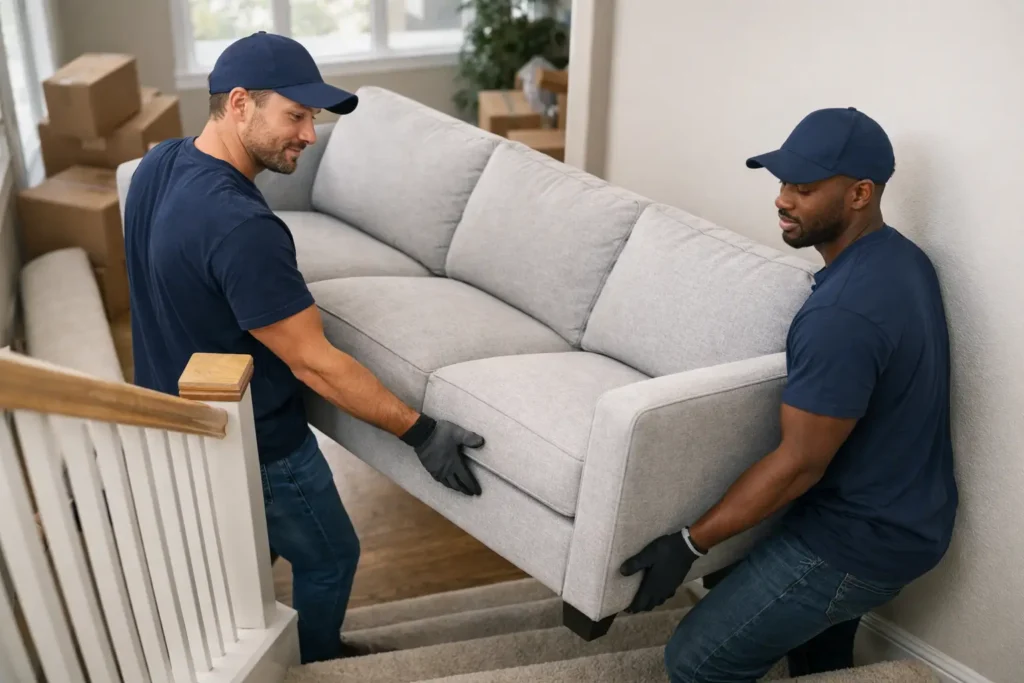
A couch can look perfectly manageable until it reaches the top stair. Then the tight turn, low ceiling, handrail, and awkward weight distribution turn a simple furniture move into a real risk for your walls, your back, and the couch itself. Knowing how to move a couch downstairs starts with planning the path, not muscling through it.
If the sofa is especially large, the stairs are narrow, or you are moving from an upper-floor apartment, getting help is usually the smart call. A few careful minutes of prep can prevent the kind of damage that costs far more than the move.
Measure the Couch and the Stairwell First
Before anyone lifts, measure the couch at its widest, tallest, and deepest points. Then measure the staircase width, ceiling clearance, landings, doorways, and any sharp turns. Do not assume that because the couch made it upstairs, it will come down the same way easily. Renovations, new railings, or a different route can change the available space.
Look closely at the stair landing. A couch often needs to be stood on one end, angled, and pivoted around the corner. If there is no room to turn it, removing the legs or temporarily taking off a door may create the clearance you need. Never remove a handrail unless you know it is safe to do so and can reinstall it correctly.
For apartment residents in places with lots of multi-story buildings, such as Austin, tight stairwells are common. Check building rules before moving day, too. Some properties require elevator reservations, protect-the-wall pads, or proof of insurance for certain moving services.
Get the Couch Ready for the Stairs
A couch is much easier to control when it is stripped down to its lightest, least bulky form. Remove loose cushions, throws, storage drawers, and detachable legs. Put the hardware from the legs in a labeled bag and tape that bag to the couch frame or keep it with your essentials.
Wrap exposed corners and arms with moving blankets, then secure the blankets with stretch wrap or packing tape applied to the blanket, not directly to upholstery or wood. Cardboard corner protectors can help if the couch has a wood frame or sharp feet. The goal is to protect both the sofa and the stairwell from scratches, dents, and torn fabric.
Clear the entire route before lifting. Move shoes, rugs, small tables, décor, and anything else that could become a tripping hazard. Keep pets and children in another room. Good lighting matters more than people think, especially in a dim stairwell or an outdoor stairway at dusk.
Use the Right Number of People
Most standard couches need at least two capable adults. Large sectionals, sleeper sofas, reclining sofas, and solid wood-framed pieces may need three or four people. A sleeper sofa is particularly deceptive because the folding bed mechanism adds concentrated weight that can shift while you move it.
The person at the lower end of the couch carries more of the load as it travels downstairs. That person also has less visibility and is more likely to be forced into an awkward position. Use a stronger lifter at the bottom, and make sure everyone agrees on simple commands before the first step.
Say “stop,” “down,” “turn,” and “rest” clearly. Avoid long conversations while carrying. One person should call the moves so the team does not try to pivot in opposite directions.
How to Move a Couch Downstairs Step by Step
Start by standing the couch on its end, usually with the back or arm facing upward depending on the staircase shape. This narrow orientation is often called the “high-low” position: one person supports the higher end while the other handles the lower end. The couch should be tilted only as much as needed to clear the stairs and ceiling.
The person on the lower side should step down one stair at a time while the upper person slowly feeds the couch forward. Keep the piece close to your body. Do not lock your knees or twist your torso while carrying weight. If the couch starts to slide, stop immediately rather than trying to catch it mid-motion.
At a landing, pause and reassess. You may need to rotate the couch vertically, with one arm facing the ceiling, before pivoting it around the corner. This is where measurements pay off. Move slowly, communicate, and make small adjustments instead of forcing a fast turn.
Once the couch reaches the bottom, set it down gently on moving blankets or sliders. Do not drag upholstered furniture across concrete, hardwood, or tile. Even if the fabric survives, the feet can scratch the floor or bend under the strain.
Protect Your Back, Walls, and Floors
The safest lift is a shared lift. Bend at your knees, tighten your core, and lift with your legs while keeping the couch close. If a position requires someone to reach overhead, lean backward on the stairs, or carry most of the weight with one arm, change the angle or bring in more help.
Furniture sliders can be useful on flat floors at the top and bottom of the stairs, but they are not for use on the stair treads themselves. Shoulder dollies and lifting straps can reduce strain in the right hands, yet they are not a shortcut for a narrow staircase. If your team has not used them before, the extra straps can create confusion at exactly the wrong moment.
Protect walls with moving blankets, especially around a tight corner or a painted hallway. A spotter who is not lifting can watch for contact points and warn the crew before an armrest catches a wall, railing, or light fixture.
When the Couch Will Not Fit
Sometimes the couch simply will not make the turn. Do not keep forcing it. Repeated pushing can damage the stairwell, tear the upholstery, crack the frame, or injure someone.
First, try a different orientation. Removing legs, doors, or a removable chaise can make a major difference. If the couch has a sectional connection, separate the pieces and move each one individually. Check whether the back is removable, but only follow the manufacturer’s instructions. Taking apart a structural section without knowing how it reconnects can create a bigger problem later.
If there is no safe stair route, consider an alternate exit such as a ground-level patio door, a balcony route handled by experienced professionals, or temporary storage until a better plan is available. Do not attempt to lower a couch over a balcony with ropes unless trained and properly equipped crews are managing the job.
Hiring Labor Help Can Save the Day
There is a point where a couch move stops being a DIY favor and becomes a job for reliable moving labor. That point may be a third-floor walk-up, a heavy sleeper sofa, a narrow turn, an injury concern, or simply a move day with too many other tasks competing for your attention.
College Movers provides labor-only help for jobs like this, so you can keep your own truck, trailer, or storage container and get motivated local college students to handle the heavy lifting. At $50 per hour per mover, it can be a practical option for apartment moves, furniture rearranging, loading, unloading, and those stressful stair carries that should not fall on one friend with a bad back.
When you book help, describe the couch, the number of flights, the stair width, parking situation, and whether there are tight landings. Honest details help the crew arrive prepared and help you schedule the right number of movers.
A Safer Way to Finish the Move
Before carrying the couch downstairs, take one last walk through the route with your team. Confirm the doors are open, the path is clear, the blankets are secure, and everyone knows who is leading. If anything feels unstable before the first step, it will not feel better halfway down the stairs.
A careful plan protects more than furniture. It protects your home, your deposit, and the people helping you. When the job calls for more hands, book straightforward labor help and let a hardworking crew take the weight off your move day.
Helpful moving resources
Before you lock in the plan, compare your timing with our moving labor estimation guide, review our simple College Movers pricing, or book online when you are ready to reserve student moving help.